
Camino de Santiago
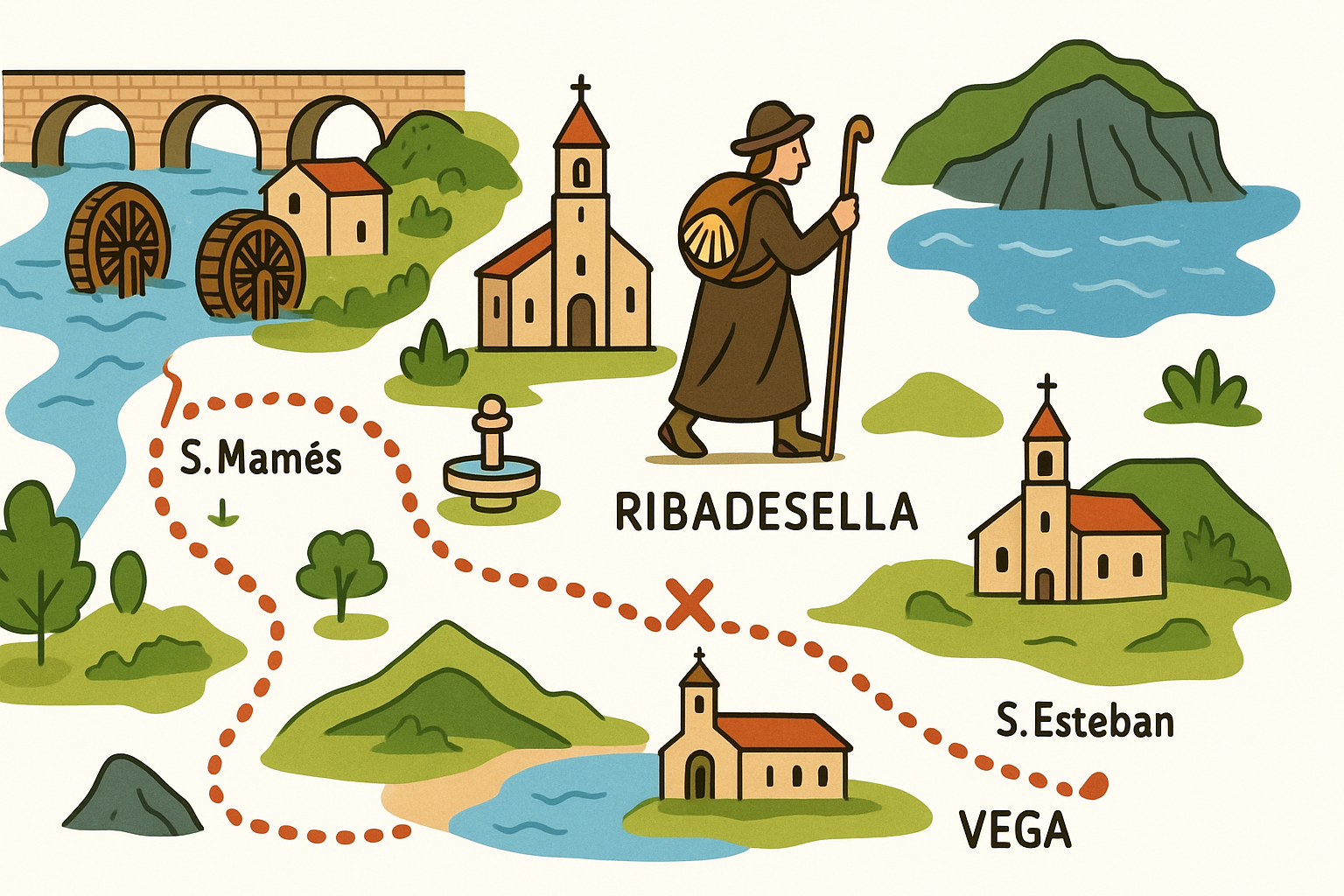
The Way reaches Cuerres , crossing a medieval bridge over the Guadamía/Aguamía River. The Church of San Mamés and its 18th-century fountain are particularly noteworthy.
From there you pass through Toriellu , following the railway line, then climb Cuetu la Barca and descend towards Ribadesella, skirting places like Palu Verde and El Infiernu , spectacular cliffs next to Camangu and Meluerda.
In Espina , near the Arra rocky outcrop, you can access the AS-379 road, with the possibility of visiting the church of San Martín de Collera .
Formerly, the estuary was crossed by boat; today, it is crossed by the bridge and the N-632. The road is left next to the institute to go to San Pedru , a town with a floral tradition.
A steep slope leads to Abeu , with views of the sea and the mountains. Nearby are the Romanesque church of San Esteban de Leces , the Ruiz de Junco tower , and the Pilgrim Hostel .
Continue towards El Forniellu , an ancient Roman settlement, and through the areas of Torre and Barréu descend along a cobbled path towards Vega beach .
Until 1988 there was a stone bridge over the river, which was replaced by a modern one after a flood.
The Camino climbs to Berbes along the old royal road, offering coastal views. Napoleonic troops were stationed there, at the hamlet of El Parapetu, during the War of Independence.
You exit onto the N-632 through the rock-carved passage called La Caleyona and cross the bridge over the Cerracín River , the boundary with the council of Caravia.


